Looking for more?
There are four important questions to answer about my fresh milled flour journey, and I thought they each deserved their own feature- “Who am I?”, “Why am I doing this?“, “What does home milling look like?“, “What do I need to start my own home milling journey?”
So I’ve convinced you to try Fresh Milled Flour? Now the overwhelming number of questions start about what you need to truly make this a part of your life. In my opinion, you need the following:
- A mill
- A heavy duty mixer (technically you can hand knead!)
- Some space for the grains to be stored
- Grains
- A few tools that make life easier
- Where to buy grain
I think I should note here that technically you can order fresh milled flour from some mills, but fresh milled flour with the oils from the germ still present starts to lose nutrients and oxidizes reasonably fast. It’s great for testing out fresh milled flour, but to reap the full benefits you’ll want to mill at home on baking day.
Picking a Mill
So let’s start with the picking a mill – this is the most expensive part of your investment to switch to this lifestyle. There are two types of mills available for home use- stone grinders and impact mills.
Impact mills tend to be a lower price, require less guesswork in adjusting the coarseness, but can make the flour hotter, cannot re-mill anything, and do not allow for coarse enough for ‘cracked corn’ or ‘cracked wheat’. Impact mills mill into an enclosed container, this will require being seated correctly and will need cleaned on occasion, and they also tend to take up more countertop space. They mill very quickly and you can place the grain in before you start the motor. These tend to be a higher pitch noise and are sometimes described as louder than stone mills.
Stone mills are more expensive, require a bit more practice for setting the coarseness, produce flour at a lower temperature, can be re-milled, and can produce a wider variety of coarseness. Stone mills are typically called ‘self cleaning’ because you don’t need to disassemble to clean, just run some rice through it, but they will output into any bowl you place under it, so there’s a bit of flour dust put into the air. (I find it’s still less mess than I’d manage to make scooping commercial flour out of a canister!) These tend to be more compact appliances, but you shouldn’t add the grain until you’ve turned the motor on. These are described as a lower pitch noise, mine is about the same noise level as a vacuum.
I should mention there are also hand grinders, but when I was researching the recommendation is to not have these as your primary mill because it will take you 20+ minutes to mill the grain for each loaf of bread.
| Mill Type | Mill Name | Price | Warranty | Motor |
| Impact | Nutrimill Impact | $199 | 5 years | 1200 watt |
| Impact | Nutrimill Classic | $299 | 5 years | 10 amp |
| Impact | Wondermill | $299 | limited lifetime | 1250 watt |
| Stone | Nutrimill Harvest | $449 | 5 years | 450 watt |
| Stone | Komo Fidibus | $449 | 14 years | 260 watt |
| Stone | Komo Mio Eco | $319 | 14 years | 260 watt |
| Stone | Komo Mio | $339 | 14 years | 360 watt |
| Stone | Mockmill 100 | $354 | 6 years for arbo housing | 360 watt |
| Stone | Komo Classic | $579 | 14 years | 360 watt |
| Stone | Mockmill 200 | $435 | 6 years for arbo housing | 600 watt |
| Stone | Komo XL | $739 | 12 years | 600 watt |
I see a lot of people looking at the Kitchen Aid attachments, but the reviews from those who have tried them for fresh milled flour say that they technically work, but cannot mill fine enough. There are lots of others available, but when I was doing my research the ones in the chart were the most reliable and I feel confident recommending any of them.
I opted for the Komo Mio because it is the same inside components as the Komo Classic. I opted for the Komo brand because of the length of time they’ve been in business and the warranty, and compared to the similar sized Mockmill motor, it was a better price point and partially made of wood instead of all the arbo-‘plastic’ material. I also heard better reviews on the bowl adjustment instead of the Mockmill lever. If money had not been an object, I’d have purchased the Komo Classic in Walnut because it was *so* pretty.
Picking a Mixer
Technically we don’t need a mixer to bake, but we all know that standing in the kitchen kneading dough is probably not going to sell someone on switching to homemade bread goods! When mixer shopping, be sure that the mixer has a good strong motor. Once you start baking several things every week it seems to burn up quite a few motors. Many don’t recommend the Kitchen Aid for fresh milled flour, but I haven’t had an issue with mine once so far!
Storage Requirements
Grain storage can get as big as you want it to be! But you can also keep it small, it just depends on your storage space. Buying in large bulk will provide you the better price point, but not everyone has storage for 50 lbs of grain! Personally, I utilize gamma lids on 3.5 gallon buckets, and 1/2 gallon glass ball jars in a cabinet inside my home. (I started with quart sized jars and they just weren’t quite big enough for my big baking days!) Gamma lids have twist off tops which makes them easy to access, and 3.5 gal buckets fit almost exactly 25 lbs of grain. They’re also still moveable at 25 lbs- I for one would struggle trying to pick up 50 lb buckets! I go out to the garage and refill the jars for my once a week big prep day where I make all the breads and muffins.
You can also purchase in 5 lb increments from most online retailers (including Amazon), which I did to try to find my favorite grains. This is not the most economical way to get grain.
Picking Grains
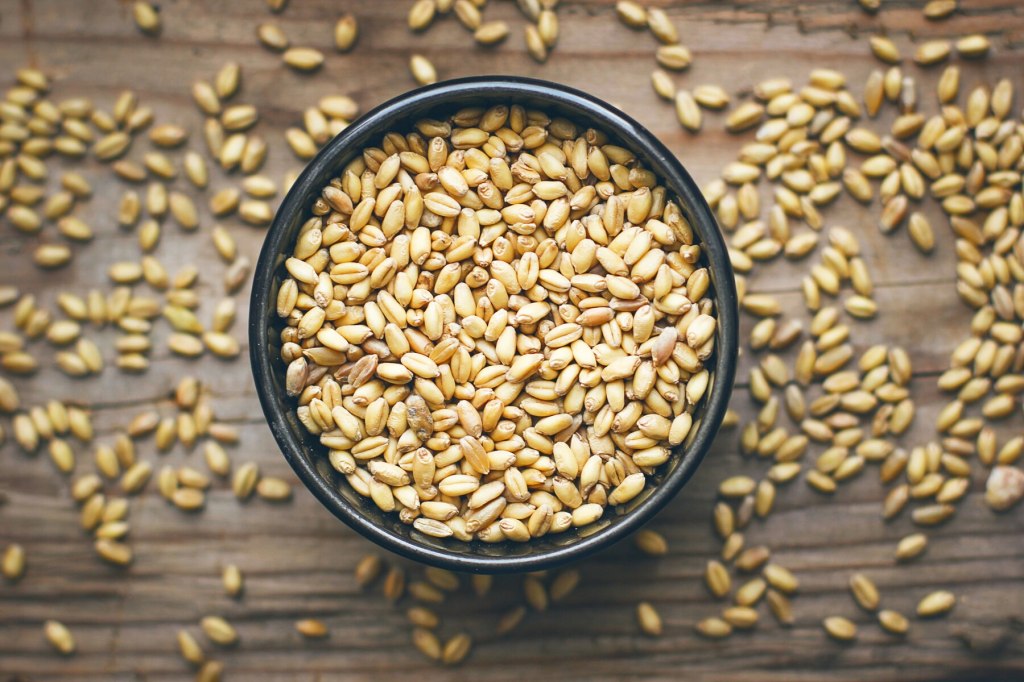
There are a lot of different types of grains, but we’re going to focus on the most commonly milled. They are broken down into categories:
- Hard White- this is ideal for yeast breads because it has a higher gluten protein content. Without the high gluten, your bread will not create a great structure and won’t get a good rise. Examples include sandwich breads, cinnamon rolls, hamburger buns, etc
- Soft White – this is a lower gluten protein content and is typically used for baked goods that are leavened with baking soda/baking powder. Examples include cookies, cakes, donuts, biscuits, etc
- “Ancient Grains” – these tend to fall outside of the hard/soft descriptions
| Grain | Amount of Gluten | Flavor Profile | Best Uses |
| Soft White Wheat | Low | Mild, sweet | pastry, cookies, cakes, pies, roux |
| Hard White Wheat | High | Mild, sweet | Bread, Rolls, can also be added to cookies, cakes, pies, or anything |
| Soft Red Wheat* | Low | Earthy, Nutty, Hearty | Cookies, Cakes, Pies |
| Hard Red Wheat | High | Earthy, Nutty, Hearty | Bread, Rolls, can also be added to cookies, cakes, pies, or anything you want the hearty wheat flavor |
| Durum | High | Rich, nutty | Pasta, bread, pizza dough |
| Einkorn | Moderate** | Earthy, nutty | Breads, muffins, cookies |
| Emmer (Farro) | Moderate | Chewy, Nutty | Pasta, bread, pizza dough |
| Khorasan (Kamut) | Moderate | Buttery, Nutty | Breads, muffins, cookies, savory breading |
| Rye | Moderate/low | Tangy, Earthy | Breads, crackers, recommended to combine with regular wheat |
| Spelt | Moderate | Nutty, Sweet | Muffins, Cookies, Cakes, Pies, Breads, Rolls, cream of wheat, roux, breading |
Footnotes
*This is not something I’ve seen commercially but is grown locally in Indiana
**Einkorn gluten is a different structure than other wheats, it is short and brittle and often tolerated by people with gluten sensitivities.
I personally found that I like to keep: Hard White, Soft White, Hard Red, Spelt, Khorasan, and Rye (only because my husband loves rye bread). I’ve yet to try Emmer/Durum, but I’d like to find one for pasta next. If I had to pick 3 to only ever have on hand, I’d pick Hard white, Spelt, and Soft White.
A few tools to make life easier
As always, you don’t *have* to have these, but almost all the recipes for FMF (fresh milled flour) require a kitchen scale. I also love my danish dough whisk, a cast iron bread pan, sunflower lecithin (not required but does make the bread much softer), and a bag of vital wheat gluten (also not required but my bread got much fluffier and sturdier after I started adding it!)
Where to buy grain
The most common places to buy grain are either online, through a drop ship company called Azure, or found locally at Amish store, feed lots (be sure to ask for human consumption quality!), or co-ops that sell directly from the farmer. Regretfully, if you’re wanting to buy locally you’ll need to do some research and make some calls.
Here’s a list of online places I’ve seen recommended, but I personally have only purchased from Azure and a local co-op. Azure’s prices are much better than the local store, but the grain quality isn’t as nice. It’s not bad and I ordered a second time, but I will probably try a new place to order for my next big order!
- Country Life Foods
- https://www.ancientgrains.com/
- https://www.benchviewfarms.com/
- https://www.guardiangrains.com/
- https://www.janiesmill.com/
- https://bluebirdgrainfarms.com/
- https://centralmilling.com/
- Bread Beckers




 Milling it Over
Leave a comment